
From distrust to friendship: Chiang Ching-kuo and Lee Kuan Yew
You may have heard of Chiang Ching-kuo, Taiwan’s former president and son of Chiang Kai-shek. What you may not know is that Chiang shared a close friendship with Lee Kuan Yew, and that he faced many difficulties in choosing a successor and preserving his father’s legacy. Commentator Gu Erde tells us lesser-known stories about Chiang, which have recently come to light with the declassification and release of previously unseen historical sources, such as Chiang’s personal diary.

On 13 January 1988, Taiwan’s President Chiang Ching-kuo — who had long suffered from diabetes, blurred vision and mobility issues — passed away at the age of 78. Over the past 37 years, some in Taiwan have attempted to deify Chiang, reminiscing about the “good old days” of authoritarian rule in contrast to the social conflicts and disorder brought about by democratisation. Others, in the spirit of transitional justice, have accused Chiang — who was once responsible for political, espionage and intelligence work — of being the prime mover behind the White Terror.
With the public release of Chiang’s diaries and the declassification of diplomatic archives from the US White House and State Department, scholars such Lin Hsiao-ting and Chen Tsui-lien have proffered a more comprehensive understanding of Chiang and his era of governance after scouring these historical materials.
This article mainly relies on the studies of the both aforementioned scholars, as well as the recollections of media personality Cheng Pei-fen, who is familiar with the Chiang family. In the article, the scholars discuss Chiang from two perspectives: firstly from his relationship with the late Singaporean leader Lee Kuan Yew, and secondly, regarding his attitude towards Taiwan’s democratisation and the succession of the Chiang family.
Initially, Chiang was wary of Lee and his left-leaning political ideology.
Chiang and Lee: a rough start to their friendship
It is well known that Chiang and Lee shared a friendship that spanned nearly two decades. But what was the genesis of their relationship?
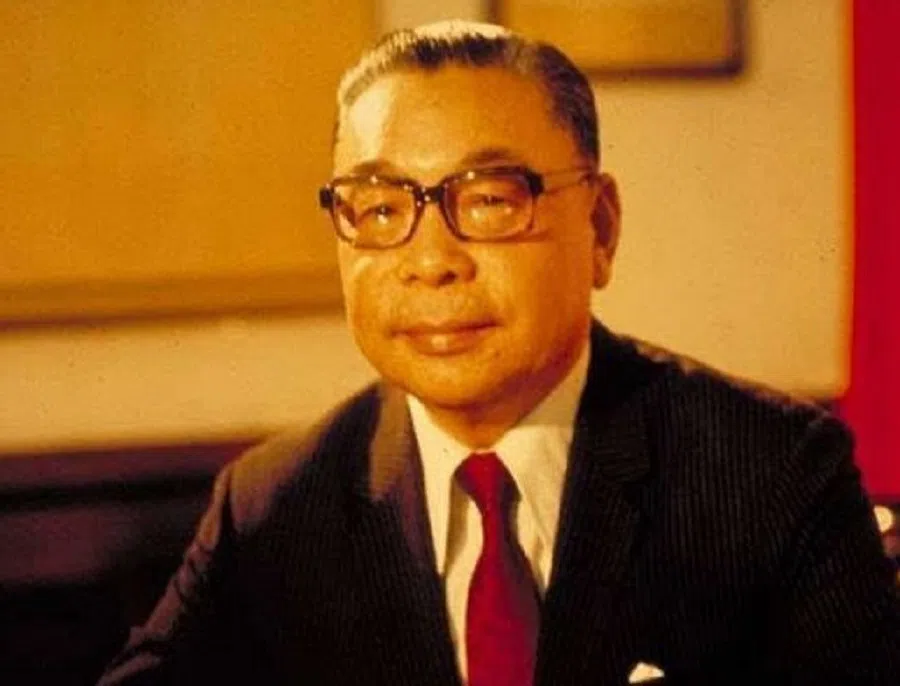
Initially, Chiang was wary of Lee and his left-leaning political ideology. Before Singapore separated from the Federation of Malaya, Lee led the People’s Action Party (PAP) in the 1959 elections for the self-governing state. At the time, the Chiang political regime in Taiwan thought Lee was too left-leaning and close to the Malayan Communist Party, so they secretly supported Lee’s political rival, Lim Yew Hock, leader of the Singapore People’s Alliance. In 1958, Lim even sent Education Minister Chew Swee Kee and Malayan Prime Minister Tunku Abdul Rahman’s private representative Mohamed Ismail Mohd Yusof to Taiwan to seek assistance and cooperation with the Chiang family.
In the 1959 election, Lee defeated Lim, prompting Chiang to note in his diary that “the left-leaning PAP has won, while Lim Yew Hock whom we supported has failed. This is yet another lesson in political warfare”. However, he remained pessimistic about Lee, and believed that the PAP would “absolutely not last”. His prediction was later proven wrong.
“We met and talked many times, and I find him to be a very pragmatic politician devoid of political ideology, though he is skilled at exploiting all sorts of contradictions for self-preservation”. — Chiang Ching-kuo on Lee Kuan Yew
The Chiang regime continued to keep its distance from Lee after the PAP won. In 1965, after Singapore declared its independence from the Federation of Malaya, national defence and security became key issues for Singapore’s survival — especially after Britain announced in 1967 that it would completely withdraw from Singapore within eight years, before bringing the deadline forward the following year to complete the withdrawal by 1971.
Lee thus decided to seek Taiwan’s assistance, with a main reason being the cultural and linguistic affinity between Singapore and Taiwan, coupled with the fact that the Chiang regime posed no territorial threat to Singapore. In 1967, Chiang, who was Taiwan’s defence minister then, personally approved the plan to assist in building Singapore’s military. He wrote in his diary that cooperation with Singapore would be “a boon for the anti-communist efforts in Asia”.
A turning point
In 1973, Lee, on the advice of Taiwan’s National Security Bureau Director Wang Yung-shu, made his first visit to Taiwan. Chiang personally welcomed Lee at the airport, and accompanied Lee on tours around Taiwan. Although there was a bit of a language barrier — Lee was fluent in both English and Mandarin, while Chiang’s English was not fluent and he spoke Mandarin with a strong Zhejiang accent — the two were still able to communicate in Mandarin.
... the Chiang regime had likewise “exploited all sorts of contradictions for self-preservation”.
In his memoirs, Lee wrote that the both of them found that they “shared a common enemy” in communism. However, Chiang remained cautious of Lee during their first meeting, noting in his diary that “Lee Kuan Yew’s name is well-known. He is here in Taiwan for a private visit this time around. We met and talked many times, and I find him to be a very pragmatic politician devoid of political ideology, though he is skilled at exploiting all sorts of contradictions for self-preservation”.
This comment also reveals that Chiang was shrewd and cautious himself. In fact, the Chiang regime had likewise “exploited all sorts of contradictions for self-preservation”. In the late 1960s, when the US prohibited Taiwan’s armed provocation towards Beijing, Chiang Kai-shek once considered exploiting Sino-Soviet tensions to realise his dream of “retaking the mainland”.
Having lived in Russia and being well-versed in Russian, Chiang Ching-kuo naturally took on the task of secret negotiations with Russia. However, unlike his father, Chiang did not let the dream of national restoration cloud his judgement and remained cautious, acting as a stop-gap against Soviet inducements.
March 2025 marks the 10th anniversary of Lee’s passing. In his life, Lee maintained a pragmatic and calm stance between both sides of the Taiwan Strait. He once encouraged the Thai government to recognise the People’s Republic of China, prompting Chiang to condemn him in his diary as being “greedy for small gains”. However, as Southeast Asian countries gradually recognised the Chinese Communist regime, only Singapore remained steadfast, earning Chiang’s admiration.
When Lee visited Taiwan again in 1974, Chiang wrote in his diary that “our friendship is not deep, but his visit at this time demonstrates his anti-communist stance, which is commendable”. Yet, he still believed Lee to be a “politician who could make use of various factors”. In May 1976, Lee Kuan Yew made his first visit to Beijing, where Beijing expressed concerns about Taiwan’s Exercise Starlight training Singapore’s military. Lee, however, was undeterred.
... Lee, visibly moved, told Chien that he was “truly touched by President Chiang’s thoughtfulness and friendship”.
A blossoming friendship
From his first visit to Taiwan in 1973 until Chiang’s death in 1988, Lee visited Taiwan nearly every year; Lee also personally attended Chiang’s funeral.
With the increased interactions, Chiang and Lee developed a personal friendship. In spring 1982, Lee planned another visit to Taiwan which coincided with Chiang’s hospitalisation for eye surgery. Before his admission, Chiang specifically asked Vice-Foreign Minister Frederick Chien to fly to Singapore to express his apologies for being unable to personally greet Lee at the airport. Lee, visibly moved, told Chien that he was “truly touched by President Chiang’s thoughtfulness and friendship”.
It was also because of his friendship with Chiang that Lee — during a 1982 visit to the US — lobbied on Taiwan’s behalf to urge President Ronald Reagan not to issue the 1982 US-PRC joint communique, which restricted US arms sales to Taiwan. According to declassified CIA documents, Reagan was nearly persuaded and considered tearing up the draft communique that had been shown to Deng Xiaoping.
Their closeness of their bond was also evident in the aftermath of the 1984 Chiang Nan Incident, in which Taiwan’s intelligence agency orchestrated the assassination of Chinese-American writer Henry Liu, pen name Chiang Nan, in the US. Chiang’s son, Chiang Hsiao-wu, was later implicated as the mastermind. Owing to Chiang and Lee’s personal friendship, Chiang subsequently chose to send Hsiao-wu to Singapore to serve as deputy representative — perhaps entrusting his troubled son to an old friend for protection.
Succession struggles: the lacklustre third-generation Chiangs
Chiang Ching-kuo’s three sons, Hsiao-wen, Hsiao-wu and Hsiao-yung, all died young. Late in life, Chiang remarked that “no future generation of the Chiang family can or will enter politics”. In truth, the third-generation Chiangs lacked promise. The three brothers were not on good terms, and did not associate with each other.
According to media personality Cheng Pei-fen, in 1977 a fight between Hsiao-wu and Hsiao-yung at the official residence escalated when the former pulled out a gun to chase the latter, causing the latter to flee in terror. Chiang Ching-kuo initially hoped to groom his eldest son, Hsiao-wen, to be his successor, but Hsiao-wen suffered brain damage due to diabetes, which impaired his intellect. Chiang then recalled Hsiao-wu from his studies in Germany, and arranged for him to intern at the National Security Council.
...“the most important task of Chiang’s life was to protect the party-state legacy left by his father. In his final years, he was still tirelessly seeking ways to extend the life of the party-state”. — Chen Tsui-lien, an academic
After the Chiang Nan Incident, Hsiao-wu became distanced from the political core. Hsiao-yung was elected to the KMT Central Committee at the 12th National Congress in 1981 and re-elected at the 13th, but emigrated to Canada with his family soon after and died of oesophageal cancer in 1996.
Academic Lin Hsiao-ting acknowledged Chiang’s intentions to promote democratisation late in his life, but also noted that Chiang found it difficult to accept the opposition’s challenge to the KMT’s dominance . Another scholar, Chen Tsui-lien, argued that Chiang’s adjustments in response to changes in Taiwan’s internal and external environment were compelled by circumstances, and added that “the most important task of Chiang’s life was to protect the party-state legacy left by his father. In his final years, he was still tirelessly seeking ways to extend the life of the party-state”.
Once the Pandora’s box of democracy has been opened, there is no turning back. Any attempt to revive authoritarianism in the name of Chiang Ching-kuo would merely be a historical reversal.
This article was first published in Lianhe Zaobao as “你所不知道的蒋经国与李光耀”.
![[Big read] China’s 10 trillion RMB debt clean-up falls short](https://cassette.sphdigital.com.sg/image/thinkchina/d08cfc72b13782693c25f2fcbf886fa7673723efca260881e7086211b082e66c)